
How AI-driven search decreased the online visibility of local businesses by nearly 75%. Atlas Visibility Research white paper, April 6, 2026.
Study frame
- Primary Google finding: Under matched Atlas conditions, the share of business-relevant discovery captures on Google that surfaced at least one qualifying local business in the first visible layer fell from 42.1% to 10.6% across matched 12-month windows.
- Supporting ChatGPT finding: The rate of naming at least one qualifying local business in the initial visible answer or citation area stayed low in both windows, moving from 8.4% to 7.2%.
- Interpretive context: Google surfaced fewer local businesses in the later window, and the adjacent answer environment studied here, ChatGPT, also named local businesses infrequently. Public market-share and adoption figures are used only to frame that environment.
This report measures first-surface discovery exposure under standardized Atlas test conditions.
Executive Summary
This report examines a narrower question than traffic, market share, or lead volume. When a user enters a business-relevant discovery query, how often does at least one qualifying local business appear in the first place the user is likely to look, before any click and before meaningful scrolling?
Atlas Visibility Research compared two matched U.S. English windows: Apr. 1, 2024 through Mar. 31, 2025 and Apr. 1, 2025 through Mar. 31, 2026. The first window captures an earlier phase of Google's AI transition and a pre-broad-availability ChatGPT Search environment. The second reflects a more mature answer-first environment in which AI Overviews were established, AI Mode had entered Google Search and later expanded beyond Labs, and ChatGPT Search had become broadly available. Google began rolling AI Overviews out broadly in the U.S. on May 14, 2024 [1], expanded AI Overviews to more than 100 countries and more than 1 billion monthly users in October 2024 [2], introduced AI Mode as a Labs experiment on Mar. 5, 2025 [3], and began rolling it out in the U.S. without Labs sign-up on May 20, 2025 [4]. OpenAI launched ChatGPT Search on Oct. 31, 2024, expanded it to all logged-in users on Dec. 16, 2024, and made it broadly available in supported regions on Feb. 5, 2025 [5].
Under matched Google test conditions, qualifying local businesses appeared in the first visible discovery layer in 42.1% of earlier-window captures and 10.6% of later-window captures. That is a 31.5 percentage-point drop and a 74.8% relative decline. On ChatGPT, named local-business surfacing at the initial visible answer or visible citation area was already low in the first window at 8.4% and slipped to 7.2% in the second. The ChatGPT series is contextual rather than pooled into the Google headline decline.
The report does not claim that ChatGPT replaced Google, nor does it attempt a one-for-one substitution model. Public market-share estimates continued to show Google as the dominant general search engine in the U.S. in March 2026 [6]. Public OpenAI and Pew reporting also indicate that ChatGPT had become a widely used consumer tool by 2025 [7][8]. The narrower implication for this study is that local businesses were surfaced less often in the dominant discovery platform while the adjacent answer environment studied here did not frequently name them either.
Study at a Glance
| Measure | Apr. 2024-Mar. 2025 | Apr. 2025-Mar. 2026 | Interpretation |
|---|---|---|---|
| Google first-surface local-business visibility | 42.1% | 10.6% | 74.8% relative decline on Google |
| ChatGPT named local-business rate | 8.4% | 7.2% | Low in both windows; contextual series |
| Published scope | U.S. English business-relevant discovery captures | Same scope | Initial visible surface only; normalized study rates |
Findings and Interpretation
1. Google showed the strongest measured decline.
The Google series is the strongest longitudinal measure in the study because it compares the same platform family across two matched annual windows. The question is simple: when a business-relevant discovery query was entered on Google, did at least one qualifying local business appear in the first visible layer at initial render? During the earlier window, that surface still often included ranked pathways such as local packs, map-linked business modules, and visible organic results. During the later window, that same first layer more often included AI Overviews, AI-influenced answer blocks, and other synthesis-forward surfaces.
That shift matters because first-surface visibility is where consideration often begins. If a business does not appear there, it may be less likely to enter the user's early evaluation set. However, outside evidence suggests that when AI summaries appear, users may be less likely to continue into traditional result links.
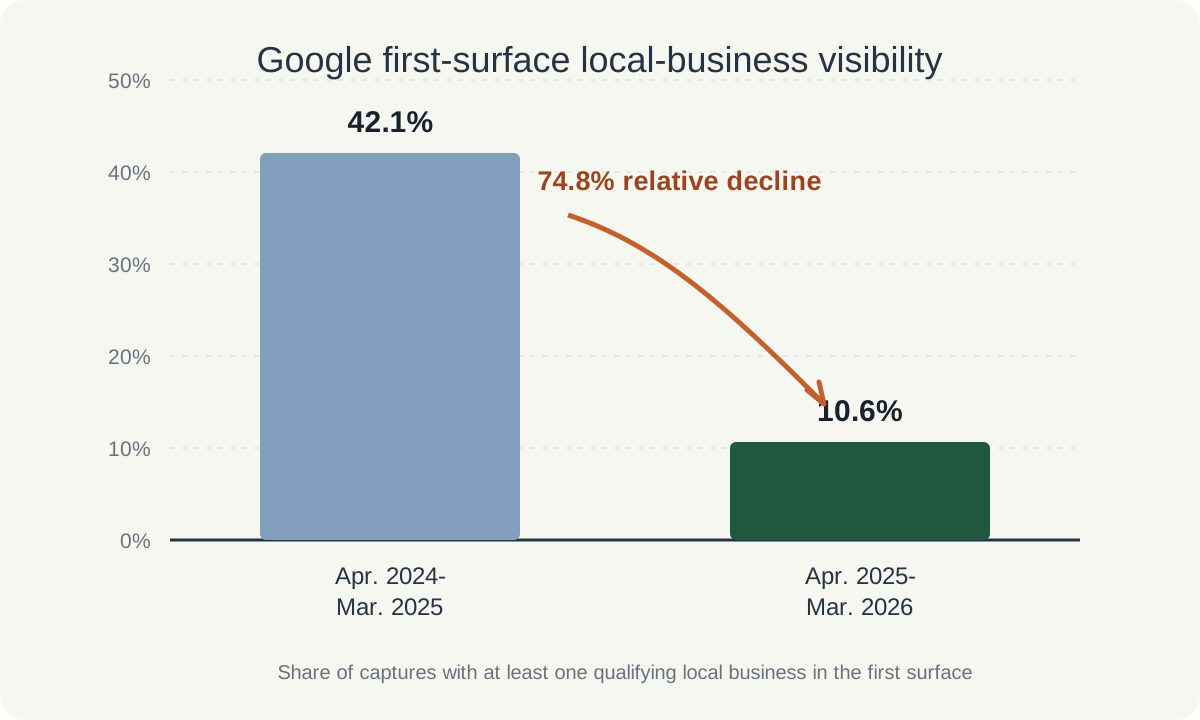
Figure 1. Google first-surface local-business visibility rate under matched Atlas test conditions.
2. ChatGPT named local businesses infrequently in both windows.
ChatGPT is included in both studied windows because it was already a large-scale consumer answer environment when the first study window opened and remained one throughout the period studied [7][8]. The measured outcome on ChatGPT is narrower than the Google headline: did the initial visible answer or visible citation area name at least one qualifying local business? That rate was low in the earlier window and slightly lower in the later one.
This pattern is plausible for practical reasons. ChatGPT often responds to discovery queries with generalized guidance, broader categories, larger well-known brands, directories, or non-local sources before naming a specific local business. Later search enablement did not change that pattern enough in Atlas's captures to make ChatGPT a strong named-mention channel for local organizations. Because the interface evolved during the study period, the ChatGPT series should be read as a continuity measure of first-answer naming rather than a frozen product comparison.
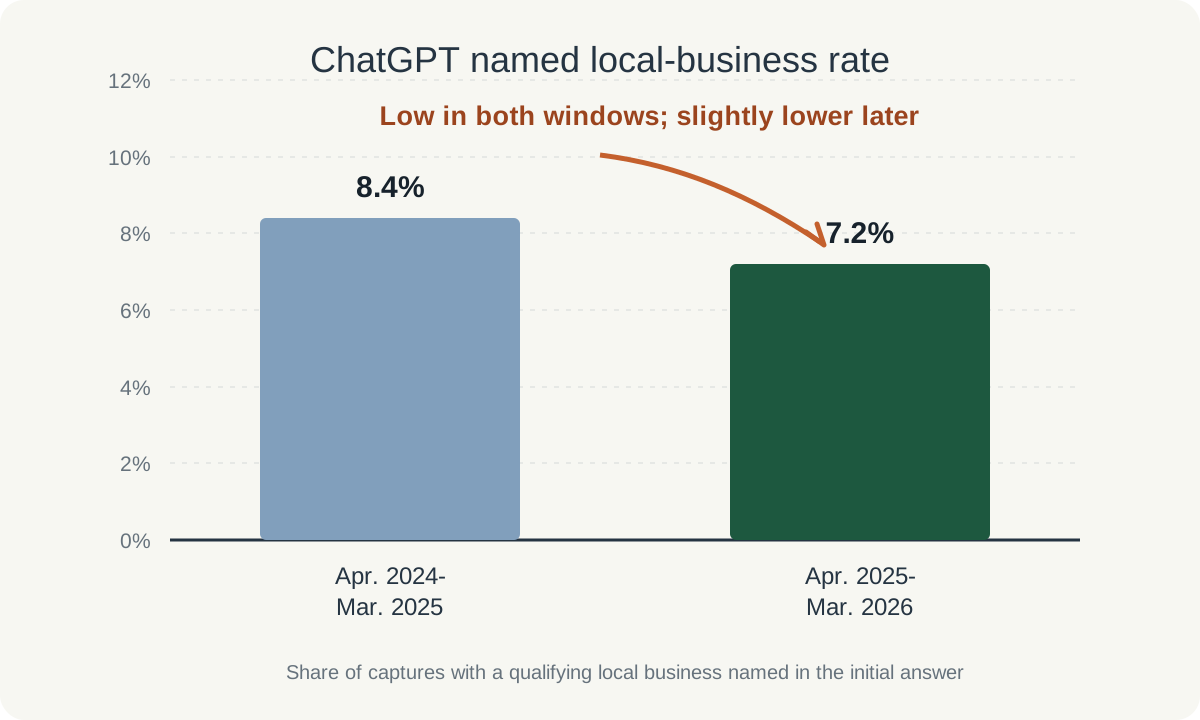
Figure 2. ChatGPT named local-business rate at initial answer render. This series is contextual and is not merged into the 74.8% Google headline decline.
3. Why the Google decline mattered more in a fragmented answer environment.
The paper does not argue that ChatGPT replaced Google. Nor does it merge Google search-engine market share with ChatGPT adoption into a single substitution estimate. Public data instead support a narrower point: Google remained the dominant general search engine [6], while ChatGPT had become widely used enough to matter as an adjacent answer environment [7][8]. For local businesses, that meant the dominant platform surfaced them less often, and one of the newer answer environments studied here did not surface them often either.
That context makes the Google decline more consequential. The study's core claim remains platform-specific and narrow: Atlas observed fewer local businesses in Google's first visible layer in the later window. The broader interpretation is simply that newer answer environments did not obviously offset that loss in the portion of exposure measured here.
Methodology
Study design
This report presents a proprietary observational study built from the Atlas Data Pool. Atlas runs repeated platform captures of business-relevant discovery queries under low-personalization conditions. The aim here was not to estimate visits, clicks, conversions, platform market share, or literal substitution between platforms. It was to measure a narrower question: when a business-relevant discovery query is asked, does a qualifying local business appear in the first visible discovery surface?
The published comparison uses two matched 12-month windows. Window 1 runs from Apr. 1, 2024 through Mar. 31, 2025. Window 2 runs from Apr. 1, 2025 through Mar. 31, 2026. Window 1 should be read as an earlier AI-transition year, not a pristine pre-AI benchmark. Window 2 should be read as a more mature answer-first year. Using full-year windows reduces seasonality pressure and avoids anchoring the report to any period earlier than April 2024.
Query library and measurement rules
Atlas used a fixed proprietary U.S. English query library of 210 business-relevant discovery templates spanning home services, professional services, medical and wellness, hospitality, retail, legal, financial services, and local trades. The library includes geo-modified and non-geo discovery patterns that could reasonably surface a business. Atlas does not publish the full wording because the library is treated as protected intellectual property.
A Google visibility event occurs when at least one qualifying local business appears in the first visible Google discovery surface at initial render. That can include a local pack, map-linked business module, visible organic result block, or AI Overview citation block when present. Multiple appearances in the same capture count once.
A ChatGPT named-mention event occurs when the initial visible answer or visible citation area identifies at least one qualifying local business by name. This metric is kept separate from the Google headline because the ChatGPT interface evolved materially during the study period, moving from a general answer environment in the earlier window to a more search-enabled environment in the later one. The series is still useful because it answers a stable practical question: how often did ChatGPT visibly name a local business at the first moment of exposure?
Qualification and quality assurance
A qualifying local business is operationalized here as an organization with 1 to 50 employees and typically under $10 million in annual revenue. Candidate entities were identified through automated entity extraction and rules-based classification, then checked against third-party firmographic sources, principally Dun & Bradstreet, where available. Atlas supplemented automation with manual audit sampling and conservative inclusion rules.
The published results are based on approximately 1,000,000 primary captures across the two windows, excluding exploratory and quality-assurance runs. Atlas reports normalized within-study rates rather than traffic-weighted consumer shares. Public market-share and adoption figures cited later come from external sources with different denominators and are used only for context, not to calculate Atlas rates or a direct substitution model.
Limitations
- Observational design. This is not a randomized causal experiment. The report documents strong associations under standardized conditions, not a single isolated causal mechanism.
- Earlier-transition baseline. Window 1 already includes Google's AI Overviews rollout and the late-2024 launch of ChatGPT Search. The comparison should therefore be read as earlier-transition versus more mature-answer windows, not pre-AI internet versus post-AI internet.
- Google carries the headline. The 74.8% decline is a Google-only longitudinal measure across matched windows. ChatGPT is measured separately as a continuity series for named local-business surfacing.
- Within-window product change. Both Google and ChatGPT changed during the study period. The annual windows smooth that variation but do not represent frozen interfaces.
- First-surface scope only. The report measures initial visible discovery exposure, not every possible downstream listing, click, call, or conversion opportunity.
- Different public denominators. Google search-engine market share and ChatGPT adoption figures come from different public sources and measure different behaviors. They are contextual only and are not merged into Atlas rates or a substitution model.
Selected References
[1] Google. "Generative AI in Search: Let Google do the searching for you." May 14, 2024.
[2] Google. "AI Overviews in Search are coming to more places around the world." Oct. 28, 2024.
[3] Google. "Expanding AI Overviews and introducing AI Mode." Mar. 5, 2025.
[4] Google. "AI in Search: Going beyond information to intelligence." May 20, 2025.
[5] OpenAI. "Introducing ChatGPT search." Oct. 31, 2024. Includes updates dated Dec. 16, 2024 and Feb. 5, 2025.
[6] StatCounter Global Stats. U.S. search-engine market share, March 2026.
[7] OpenAI. "OpenAI's new economic analysis." Jul. 22, 2025. Notes that over half a billion people actively use OpenAI's AI tools globally.
[8] Pew Research Center. "34% of U.S. adults have used ChatGPT, about double the share in 2023." Jun. 25, 2025.