
Why “Being Good at What You Do” No Longer Guarantees Visibility
Attorney Reputation In The Age Of AI: Why Good Work No Longer Guarantees Visibility
Clients now ask Google and ChatGPT to help them choose an attorney. This piece explains what changed, why strong firms can become invisible, and what reputation protection looks like now.
The Quiet Shift Most Attorneys Miss
A lot of attorneys think the internet is still doing the same job it did ten years ago. You put up a good website, you publish a few articles, you show up in search, and people find you when they need you. That model was never perfect, but it was stable enough that you could ignore it most weeks.
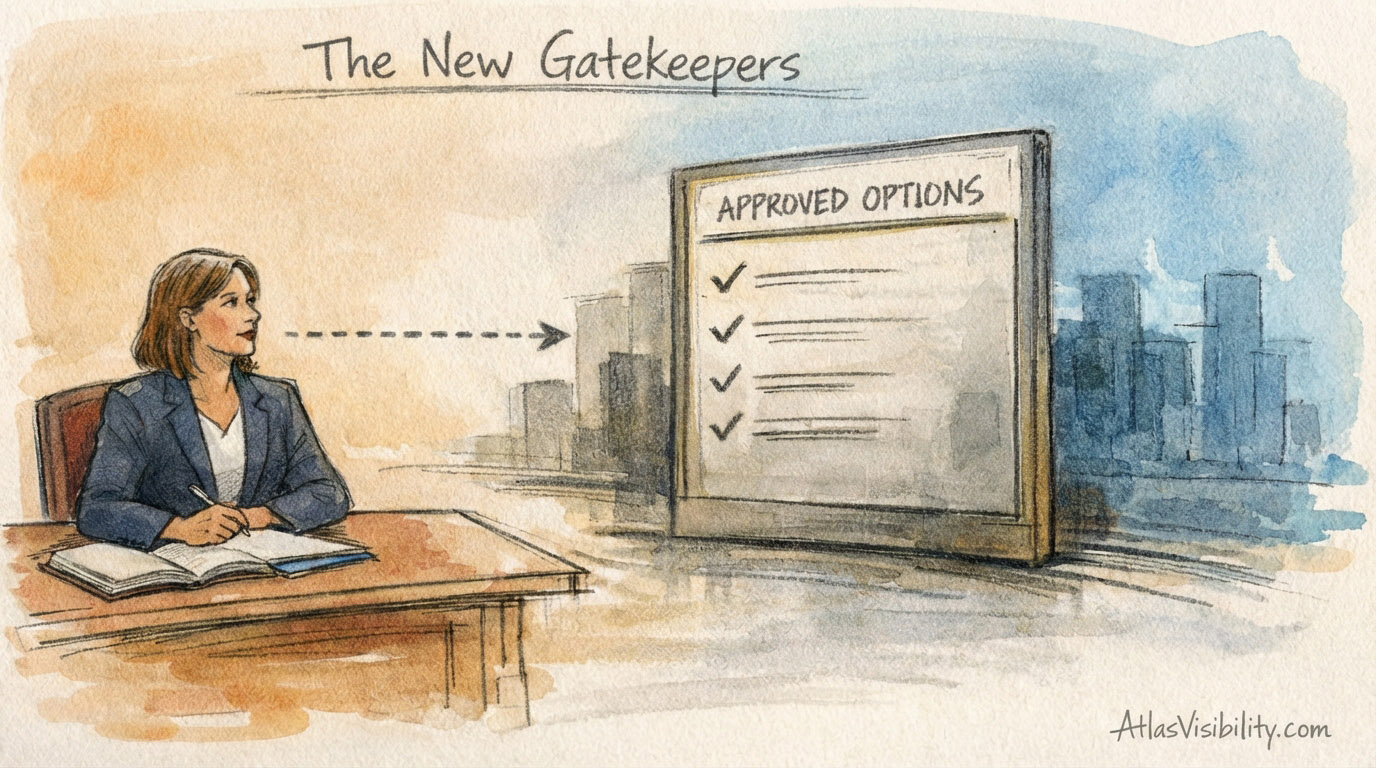
What changed is not just the tools. What changed is the role those tools play in a client’s decision. Search is no longer a directory that points people toward options. More and more, it is a gatekeeper that decides which options even get introduced.
This matters because attorneys do not have casual customers. You have people making high-stakes decisions under stress, often with limited time, and with a deep need to feel safe. When the gatekeeper changes its criteria, the consequences show up in your pipeline before they show up in your awareness.
Clients Are Not Researching, They Are Delegating
For years, we trained clients to “Google it.” That meant they would scan, compare, click around, and gradually build confidence. The process had friction, but it also had room for nuance.
AI-driven discovery removes that friction. It gives clients a single answer, a short list, or a confident summary, and it does it in a tone that sounds settled. A client who used to spend thirty minutes comparing firms can now spend thirty seconds asking a question and accepting what comes back.
That shift changes the shape of competition. It compresses the decision space, and it quietly rewards whoever is easiest for a system to understand and verify. In a world like that, being excellent is still necessary, but it is no longer sufficient.
The New Gatekeepers Do Not Evaluate You Like People Do
Human beings can sense trust in ways machines cannot. They notice how you explain a hard concept, how you handle uncertainty, and whether you take shortcuts with the truth. They also notice whether you make them feel rushed, small, or sold to.
AI systems do not have access to any of that. They do not “feel” your credibility, and they do not infer your competence from your presence in a room. They can only work with what is written, structured, repeated, and corroborated across the public web.
This is where good attorneys get blindsided. You can have a strong reputation in your community and a real track record of outcomes, and still look like a vague, low-confidence option to a machine. That is not personal, but it is not harmless either.
What A System Can Actually See
When an AI system is asked to recommend an attorney, it is trying to reduce uncertainty. It is searching for clear patterns it can repeat without taking on risk. That tends to push it toward signals like these:
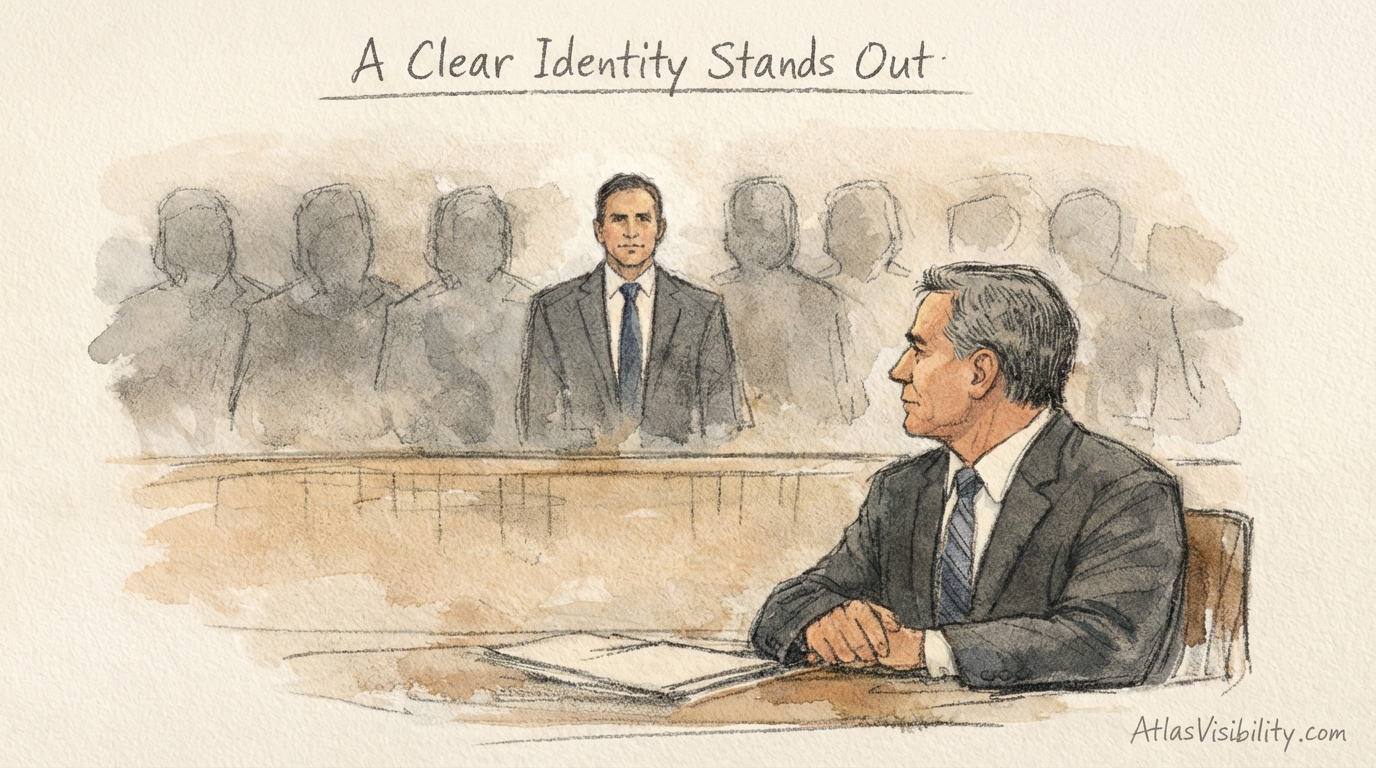
- A clear, consistent identity that matches across your website, directories, and professional platforms
- Visible credentials and experience tied to specific practice areas, not just a broad bio
- Authored, experience-based writing that sounds like a practicing attorney, not a generic explainer
- Third-party validation such as earned mentions, reputable citations, and consistent reviews
- A stable “story” about what you do that does not change depending on where a client finds you
None of this is about ego. It is about legibility. If a system cannot confidently describe you, it will avoid describing you at all.
Why Individual Expertise Is Rising Above Firm Brands
A firm name still matters, but it carries less weight when a system is trying to evaluate risk. In law, Google has long treated many topics as “Your Money or Your Life,” which is their way of saying that bad information can cause real harm. When the stakes are high, the gatekeepers look harder for credibility signals.
That is why you are seeing more emphasis on the individual. Google’s quality framework increasingly highlights experience, expertise, authority, and trust, and it rewards content that makes it obvious who is responsible for what is being said. If the words on your site feel anonymous, the system reads them as higher risk.
The same pressure shows up inside answer engines. When a tool like ChatGPT is asked a question, it does not present ten equal options. It tries to produce a single coherent response, and it leans toward sources and patterns that appear stable and trustworthy. That creates an environment where personal authority can outperform a polished brand, especially when the brand is not clearly anchored to visible experts.
The Entity Problem Attorneys Do Not Realize They Have
Modern search is deeply “entity” driven, which is a plain way of saying it tries to understand people, places, and organizations as distinct things with relationships. In that world, “your firm” is one entity, but so are you, your partners, and the other attorneys in your practice. The system is constantly trying to connect those entities to topics, outcomes, and trust signals.
If your firm’s visibility depends on a brand, but the individuals behind the brand are hard to verify, the system’s confidence drops. If a specific attorney has a clear footprint, consistent credentials, and a history of being referenced, the system has an easier job. It can connect that person to a practice area and stand behind the recommendation with less risk.
This is why “firm-only” positioning breaks down. It is not that the firm is unimportant. It is that a machine cannot trust a logo the way a human can trust a person.
Visibility Has Become A Translation Problem
Most attorneys I talk to do not want to play marketing games. They want to practice law, take care of clients, and let results speak for themselves. That posture is usually rooted in integrity, and I respect it.
The hard truth is that your work can still speak, while the systems clients rely on cannot hear it. If your credibility mostly lives in conversations, courtrooms, and private outcomes, an AI gatekeeper has no way to measure it. From its perspective, it might as well not exist.
That is why I think about this as translation, not promotion. The goal is not to get louder. The goal is to make sure your real reputation survives contact with the systems now filtering trust.
If you want a shorter, focused unpacking of how this happens, start with why being good at what you do no longer guarantees visibility. If you want a deeper look at the kinds of signals machines are actually trying to confirm, what AI actually looks for when recommending a professional is a useful lens.
The Reputation Gap Is Not A Marketing Problem
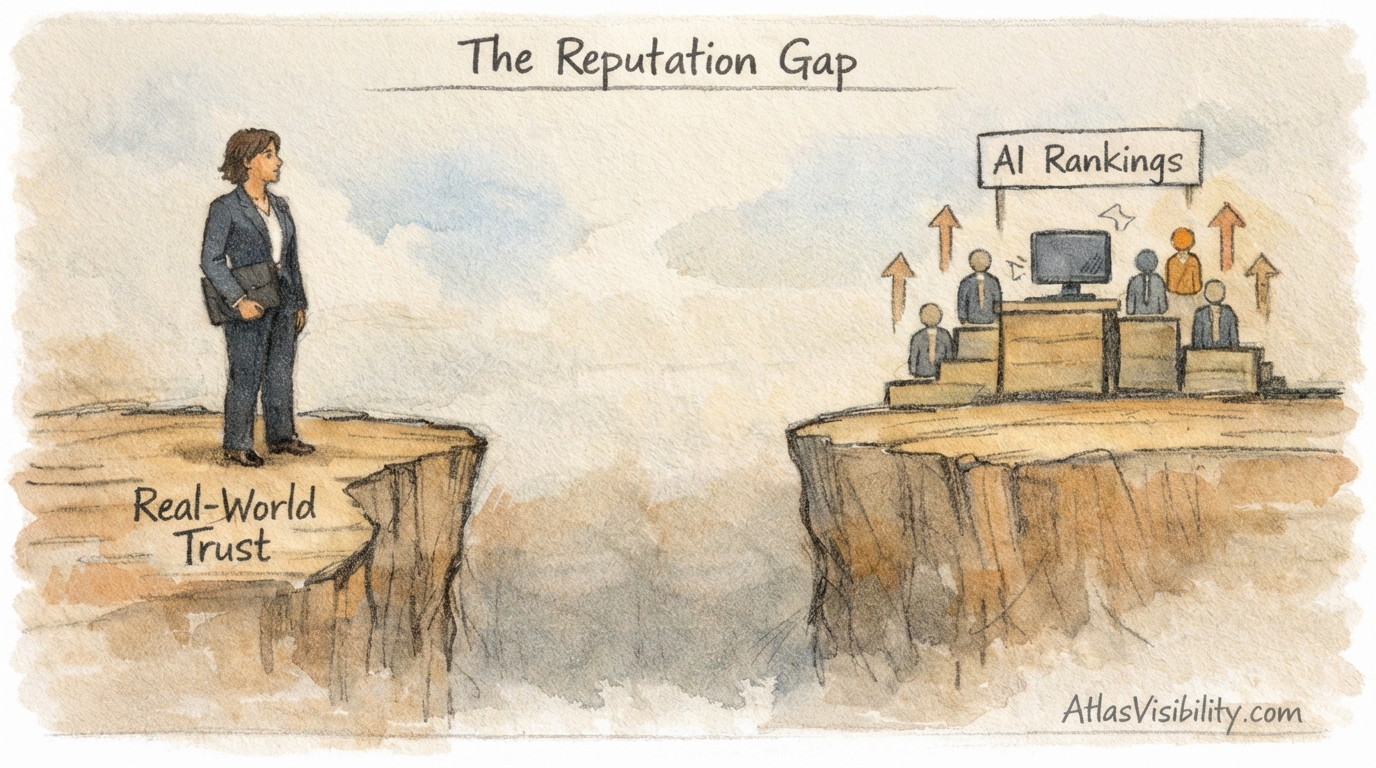
A marketing problem is usually solved by messaging, positioning, and demand capture. This is different, because the failure can happen even when your messaging is fine. The system can simply fail to connect the dots between who you are and why you should be trusted.
That gap is where good attorneys quietly lose ground. Not because they got worse, and not because their clients stopped valuing quality. They lose ground because the discovery layer stopped reflecting reality.
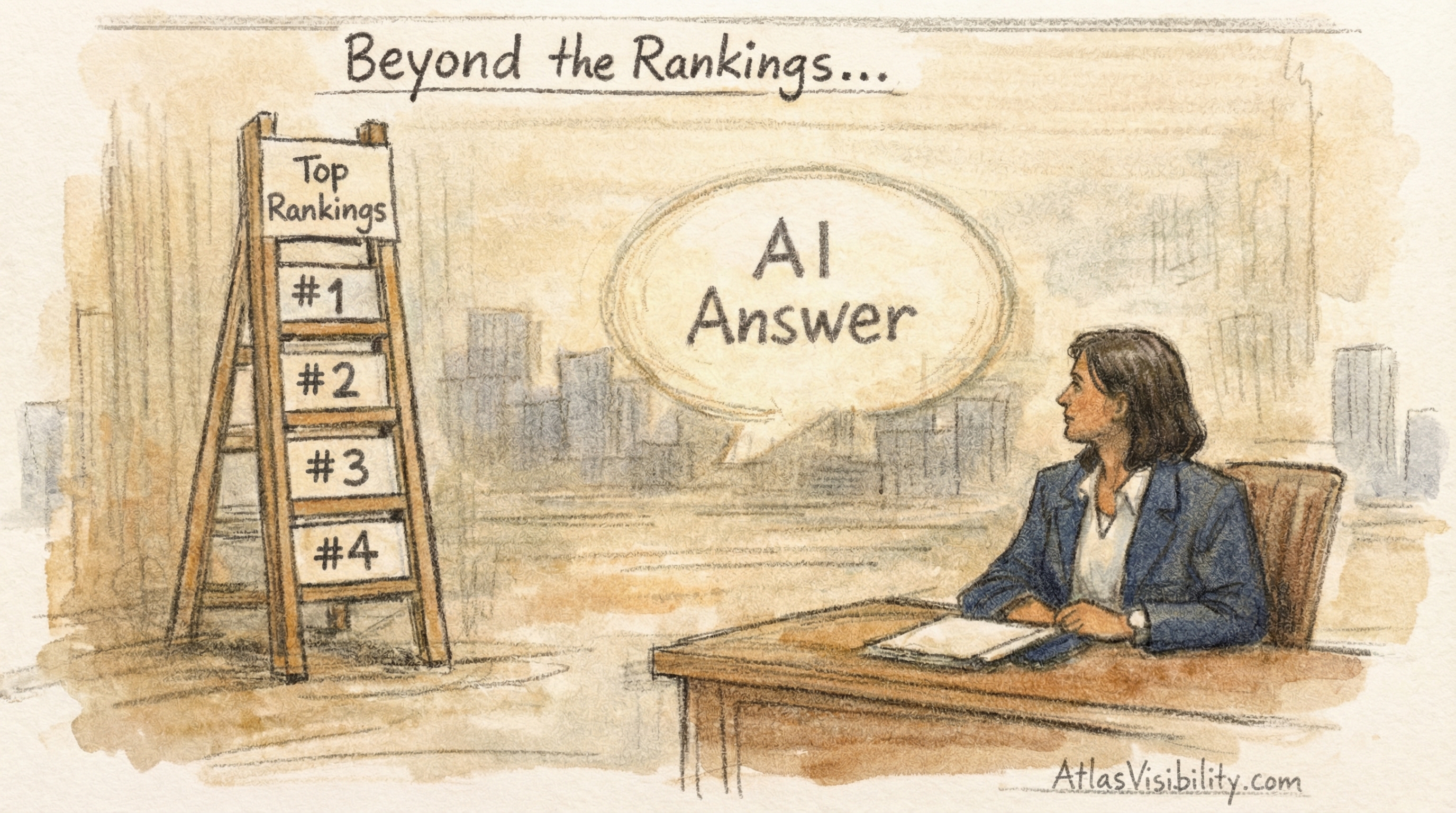
This is also why “rankings” can feel confusing right now. You can technically rank well for a term and still see weaker results, because the client never clicks through. If the answer is already on the results page, or inside an AI summary, your position can be irrelevant to the outcome.
Meanwhile, the firms that get named inside summaries and recommendations begin to feel inevitable. They become the default options simply because they are the options the gatekeeper can confidently explain.
The Long-Term Cost Of Invisibility
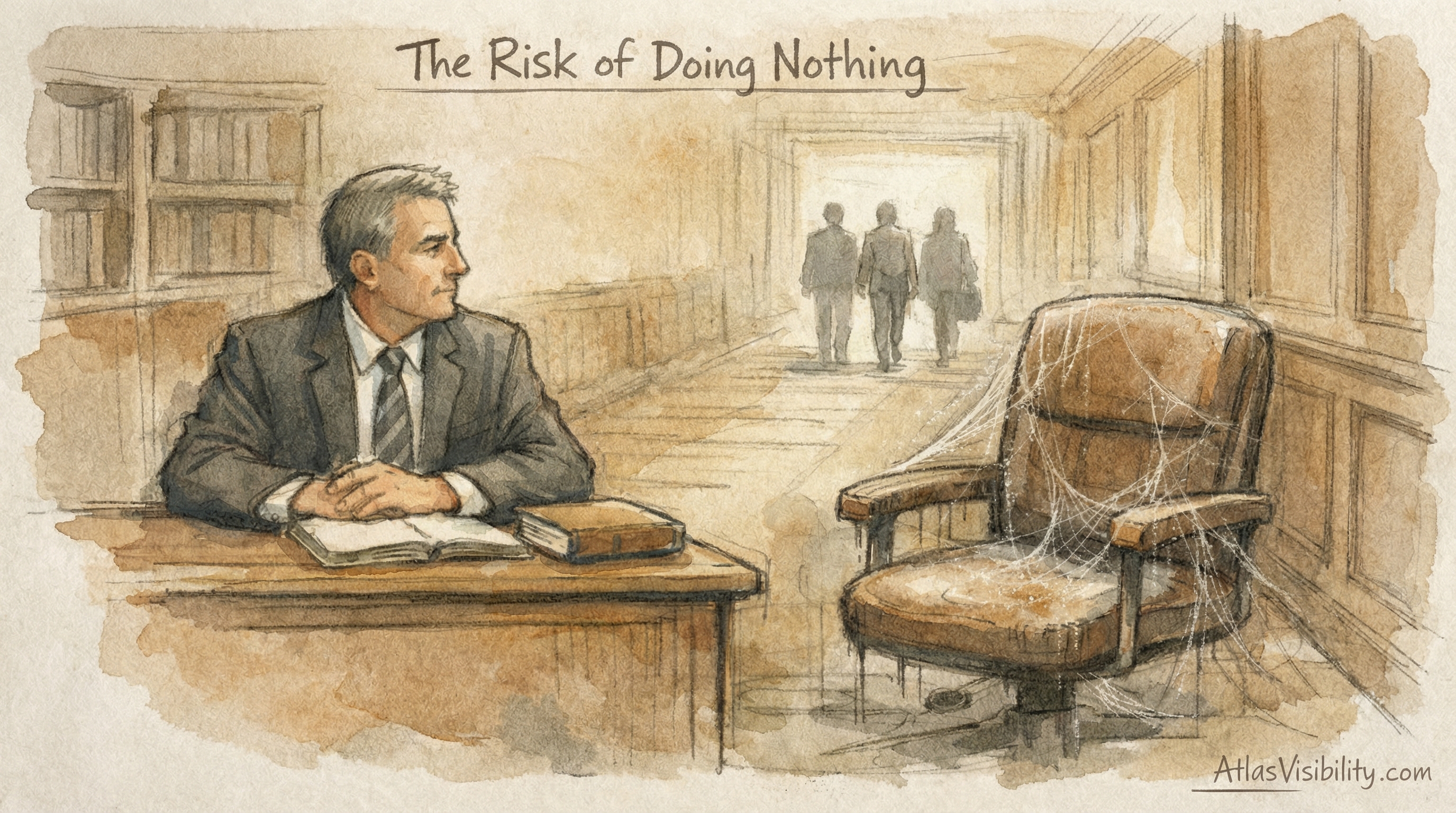
Invisibility is not a dramatic collapse. It usually shows up as a slow drift that is easy to rationalize. A few fewer form fills, a few more price shoppers, a little more dependence on paid channels, and a quiet sense that something is off.
Over time, it reshapes the quality of your practice. When strong clients have a harder time discovering you, you end up spending more energy sorting, qualifying, and educating. Your team feels the shift before you do, because they are the ones handling the incoming noise.
It also changes how your reputation is perceived inside your own market. If younger attorneys, referral partners, and local reporters can’t easily find credible signals about your work, they will assume those signals do not exist. That assumption is not fair, but it becomes real in its consequences.
This is the part most people miss. In the age of AI, your reputation is not only what people say after they work with you. It is also what systems can verify before they ever call you.
Where Atlas Actually Sits In This System
Atlas is not a search engine company, and it is not built around chasing traffic. It exists to protect the reputation of attorneys as the gatekeepers of trust keep changing. The work is about continuity, making sure your real-world credibility does not get lost in translation as discovery becomes more automated.
That posture matters because attorneys have a different risk profile than most businesses. Your license carries responsibility, your clients carry stress, and your work often touches the most consequential parts of someone’s life. Reputation is not a growth tactic in that environment. It is infrastructure.
If you want to go deeper without turning this into a full project, The Reputation Gap: An attorney’s guide to protecting your reputation in the Age of AI is free for attorneys who want to better understand what is happening to their online reputation. It is written to orient you, not to hype you.
The point is not to scare you into action. The point is to name what is already happening so you can make decisions with your eyes open.
Frequently Asked Questions
Is This Just Another Way Of Saying SEO Matters?
Search still matters, but it is playing a different role now. The old model was about getting a click, earning attention on your site, and converting over time. The new model often ends before the click even happens.
When a system answers the question directly, you are no longer competing for a blue link. You are competing to be the source the system trusts enough to reference, summarize, or recommend by name. That is less about “optimization” and more about credibility that machines can verify.
Why Do AI Systems Seem To Recommend The Same Few Names?
AI systems tend to prefer low-ambiguity choices. They lean toward people and organizations that have consistent, repeated signals across many places, because that reduces the chance of making a risky recommendation.
This is why third-party validation and consistency matter more than they used to. A system is not trying to find the best attorney in your county the way a human might. It is trying to find an attorney it can describe confidently without getting it wrong.
If My Practice Is Referral-Based, Do I Still Need To Care?
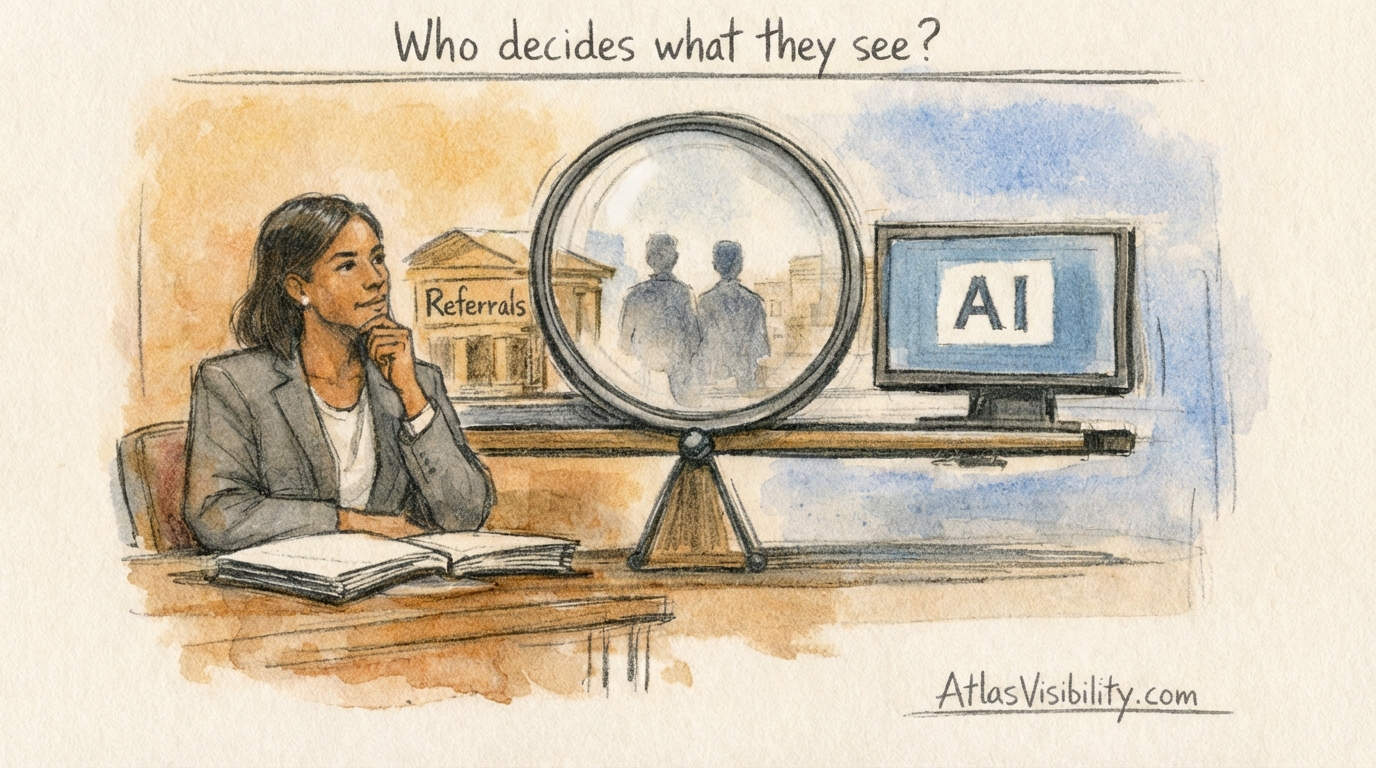
Referrals have not disappeared, but the way referrals get verified has changed. A referral partner may trust you completely, but the client still has to feel safe enough to call, and many clients now “check” you through Google and AI tools before they reach out.
If that verification layer is thin or confusing, the referral still exists, but it becomes fragile. The client may delay, comparison shop, or choose the firm that looks easier to trust online. This is not because they doubt your referrer, but because they are trying to reduce their own fear.
What Does “Protecting My Reputation” Mean In Practical Terms?
It means making sure your credibility is legible before the first conversation. Your real reputation is built through outcomes, ethics, and relationships, but your online reputation is built through signals that can be validated at scale.
When those two drift apart, you get a strange kind of injustice. You can be deeply trusted by people who know you, and quietly overlooked by the people who need you next. Protecting your reputation means preventing that drift from becoming permanent.
What If I Want A Clear Read On Where My Firm Stands?
Some attorneys want to reason this through internally, and others want an outside view of how the gatekeepers are likely interpreting their signals. If you want clarity on your specific situation, you can set up a discovery call to learn more about The Atlas Reputation System.
There is no pressure baked into that option. It is simply a way to get oriented with someone who spends most of their time watching how these systems reward trust and how they erase it.
Sources
- Google Search Central: Our Latest Update To The Quality Rater Guidelines (E-E-A-T)
- Google Search Quality Rater Guidelines (PDF)
- Google Search Central: Creating Helpful, Reliable, People-First Content
- Google Search Central: What Creators Should Know About Google’s Helpful Content Update
- Google Blog: Generative AI In Search (AI Overviews)
- Pew Research Center: Google Users Are Less Likely To Click When An AI Summary Appears
- SparkToro: 2024 Zero-Click Search Study
- Google Support: How Google’s Knowledge Graph Works
- OpenAI: Introducing ChatGPT Search
- Reuters: Google Tests An AI-Only Version Of Its Search Engine
Additional Resources
Tag
Tag
The Reputation Gap: How AI Decides Who Gets Recommended
Tag
Why Google Rankings Matter Less Than You Think in the Age of AI
Tag
What AI Actually Looks For When Recommending a Professional
Tag
The Quiet Risk of Doing Nothing: Digital Extinction for Trusted Experts
Your community needs you.
Let's make sure they can find you.